
Solo Violins in Living Room Design: Elegant Ideas Inspired by the Violin
A violin is one of the most beautifully proportioned objects ever made: a sweeping scroll, a softly pinched waist, a glowing amber finish and a few perfectly placed lines. You do not need to hang an instrument on the wall to borrow that elegance. With a few thoughtful touches, the violin's form can bring grace and quiet drama to a British living room, without making it feel themed or fussy.
Why the violin works as a design muse
Unlike many decorative motifs, the violin is made of restrained, repeating elements: flowing curves, a narrow waist (the "C-bouts"), delicate inlaid borders known as purfling, and elegant f-shaped sound holes. Its colour story is equally versatile. Warm varnished maple and spruce sit naturally beside ebony-black accents. These tones suit period terraces, Victorian conversions and modern new-builds alike.
The secret is to treat the violin as a solo performer. Choose one or two strong references and let the rest of the room play a supporting role.
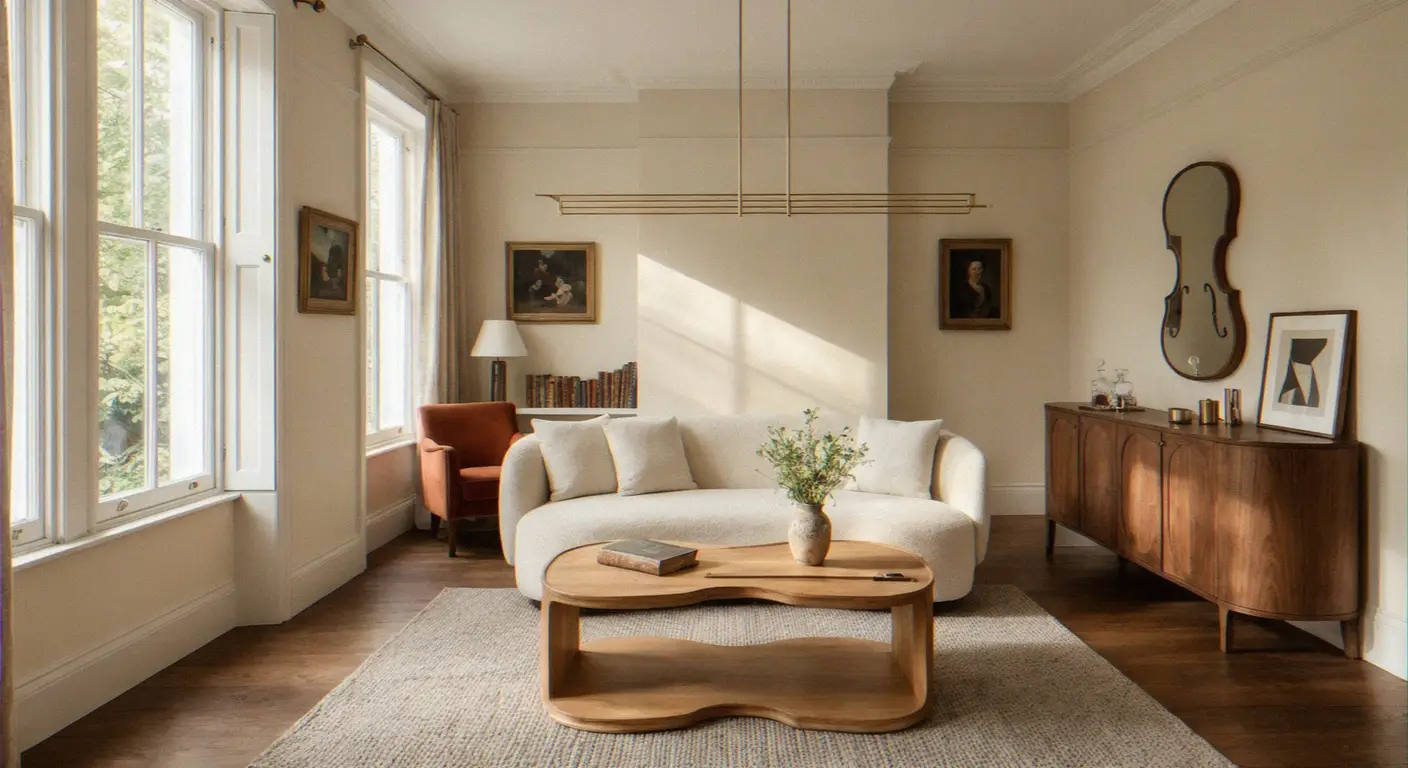
The concept: "Quiet Cremona"
Cremona, in northern Italy, is the historic home of violin making and the city of Antonio Stradivari, whose instruments are still celebrated worldwide. Our concept, Quiet Cremona, takes that craftsmanship as its mood: warm, polished, tactile and calm.
- Palette: amber, honey oak, soft walnut and muted cream, grounded with touches of ebony black or deep aubergine.
- Materials: real timber or timber veneer, aged brass, wool, linen and a little velvet.
- Lighting: warm white bulbs (around 2700K) to bring out the glow of wood grain.
Six practical ways to bring it to life
1. Choose furniture with a "waist"
A coffee table or pair of side tables with softly curved, hourglass-inspired edges echoes the violin's body and also helps traffic flow, as curves have no sharp corners to catch in a compact room. Look for oak, walnut or ash finishes.
2. Add an f-hole mirror or wall panel
The f-shaped opening is the violin's most recognisable detail. A mirror with a gently stretched, S-shaped outline, or a slatted panel with a subtle f-inspired cut-out, works as an artful focal point above a console or sideboard. Keep it to one statement piece to avoid a literal look.
3. Use "purfling" lines as fine detailing
Purfling is the thin inlaid line that runs around a violin's edge. Translate it into thin brass or dark timber inlay on a sideboard, a slim contrasting border on a rug or a narrow picture-frame moulding. These are small, affordable touches that give the room a crafted finish.
4. Echo the scroll in curves and finials
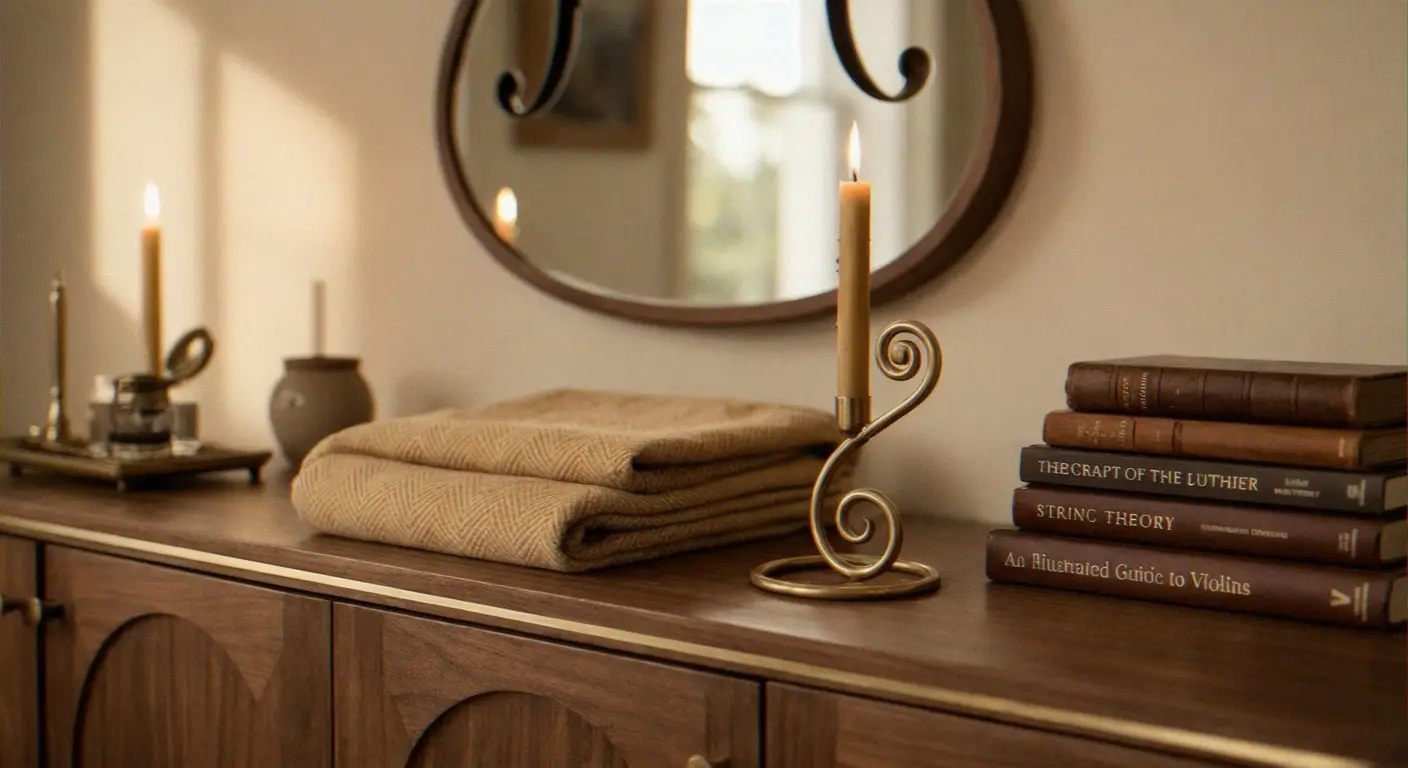
The spiral scroll at the neck of a violin can inspire a curved sofa arm, a rolled-arm chair or a spiral-shaped brass candle holder. A single scroll-like accent is plenty.
5. Light like strings
A linear pendant or a row of slim brass rods suggests taut strings above a dining or coffee area. Because the lines are slender, they add rhythm without visual weight, which is helpful in smaller UK living rooms.
6. Display one instrument as a focal point
If you own a violin or viola, a wall-mounted display hook or glazed case turns it into sculpture. Choose a wall away from radiators, fireplaces and direct sunlight, as heat and humidity swings can damage varnish and joints. Keeping the room at a stable, moderate humidity, commonly recommended as roughly 40–60%, is kinder to both instruments and timber furniture.
A simple weekend plan
- Edit first: remove clutter so the curves can breathe.
- Paint or textiles: introduce one warm tone through a wall colour, curtains or a throw. Always test samples in your own light, as north-facing rooms can make wood tones look cooler.
- Add the hero piece: choose a curved table or an f-hole mirror.
- Layer the detail: add brass accents, a linear light and a few books or sheet-music prints.
- Check the fixings: use appropriate wall fixings for the weight of any mirror or shelf, and a stud finder or professional help for heavy items.
Mistakes to avoid
- Going literal. Violin wallpaper, music-note cushions and several instruments quickly feel like a theme room. Suggest, do not shout.
- Too many curves. Balance them with a few straight lines, such as a rectangular rug or a simple bookcase.
- Cold lighting. Bright white bulbs flatten warm timber tones.
Frequently asked questions
Can I use this style in a small living room?
Yes. Curved tables and slim linear lighting are especially useful in compact spaces because they soften the layout and keep sightlines open.
Do I need to play an instrument?
Not at all. The scheme borrows shape, colour and craftsmanship, not music.
Is it suitable for period homes?
Very much so. Warm timber, brass and gentle curves sit comfortably alongside cornicing, picture rails and fireplaces.
Thinking of reshaping your living room? Try to translate a concept like this into a layout, palette and shopping list tailored to your home.